
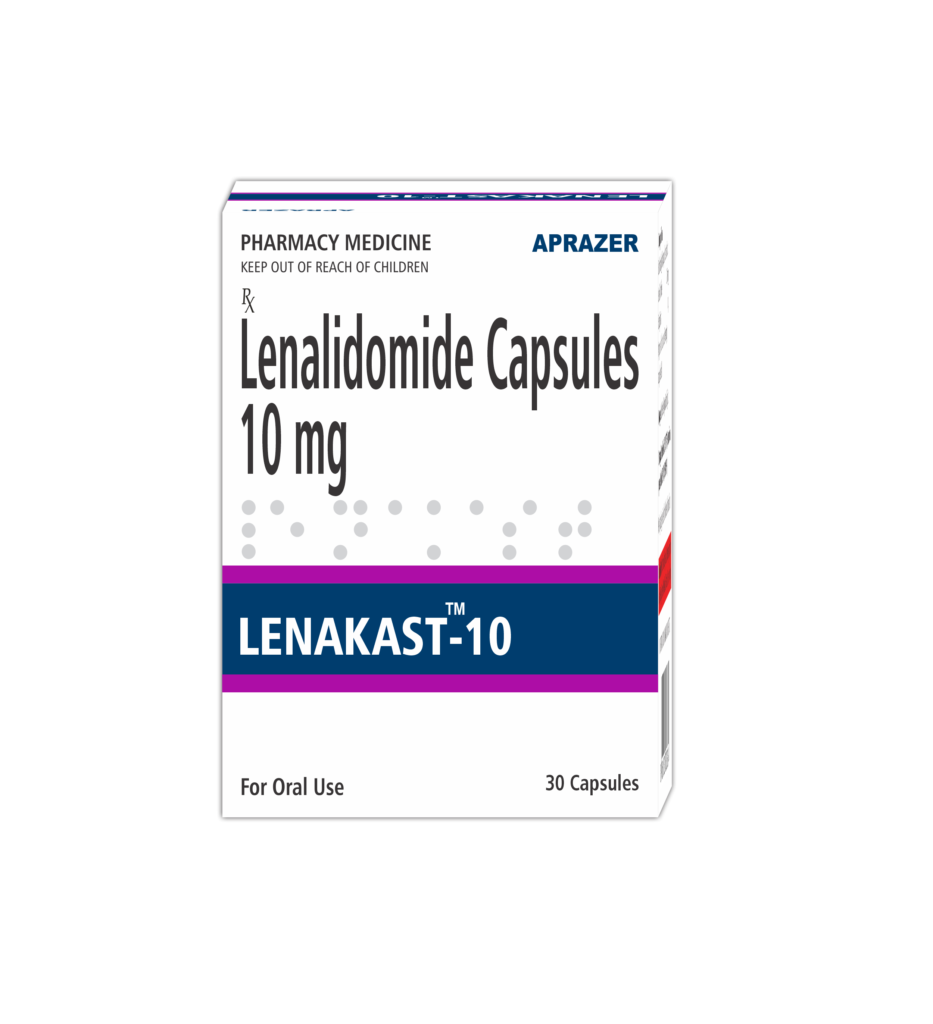
Lenalidomide Capsules
Anticancer Medicine / Immunomodulatory Agent
Lenalidomide Capsules
Aprazer Healthcare is a certified WHO-GMP manufacturer and global exporter of Lenalidomide Capsules (Lenakast 10mg, 25mg). High clinical efficacy for Multiple Myeloma and MDS.
Formulation
Capsules
Standard
WHO-GMP Certified Quality
Supply Type
Global Export & Institutional Supply
Finished Commercial Brand
Available finished formulation under our brand name Lenakast 10.
View Commercial Product Details
WHO-GMP Certified
Global Export Ready
Quality Assured
Formulation Insights
Comprehensive Medical Overview
Lenalidomide Capsules
Classification: Anticancer Medicine / Immunomodulatory AgentAbout Lenalidomide Capsules
Lenalidomide is an oral immunomodulatory agent (IMiD) with potent antineoplastic, anti-angiogenic, and anti-inflammatory properties, widely prescribed for hematologic malignancies including Multiple Myeloma and Myelodysplastic Syndromes.Lenakast (Lenalidomide Capsules) – Manufactured by Aprazer Healthcare
Lenakast (Lenalidomide 10 mg and 25 mg) is formulated under strict WHO-GMP compliance, offering proven bioequivalence, clinical reliability, and global affordability. Aprazer Healthcare is a leading oncology medicine exporter from India, distributing life-saving oral oncolytics and hospital injectables to healthcare systems across Asia, Africa, Europe, and the Americas.Approved Indications & Uses of Lenalidomide
Lenalidomide is a cornerstone therapeutic agent indicated for:- Multiple Myeloma (MM): Indicated in combination with dexamethasone for adult patients with newly diagnosed multiple myeloma who are not eligible for autologous stem cell transplantation (ASCT), as maintenance therapy post-ASCT, and for relapsed or refractory multiple myeloma.
- Myelodysplastic Syndromes (MDS): Approved for the treatment of patients with transfusion-dependent anemia due to low- or intermediate-1-risk myelodysplastic syndromes associated with a deletion 5q cytogenetic abnormality with or without additional cytogenetic abnormalities.
- Mantle Cell Lymphoma (MCL): Prescribed for adult patients with relapsed or refractory mantle cell lymphoma whose disease has progressed after two prior therapies, one of which included bortezomib.
- Follicular Lymphoma (FL) & Marginal Zone Lymphoma (MZL): Utilized in combination with rituximab (the R2 regimen) for patients with previously treated FL or MZL.
Mechanism of Action (How Lenalidomide Works)
Lenalidomide possesses pleiotropic antineoplastic and immunomodulatory mechanisms:- Cereblon (CRBN) Binding: Directly binds to cereblon, an E3 ubiquitin ligase complex component, inducing selective ubiquitination and rapid degradation of transcription factors Ikaros (IKZF1) and Aiolos (IKZF3).
- Cytotoxic & Anti-Proliferative Effects: The loss of IKZF1 and IKZF3 downregulates IRF4 and MYC, leading to direct G0/G1 cell cycle arrest and apoptosis of malignant plasma cells and del(5q) clones.
- Immunomodulation: Stimulates T-cell proliferation and co-stimulates cytotoxic T lymphocytes and natural killer (NK) cells to eliminate cancer cells.
- Anti-Angiogenesis: Blocks endothelial cell migration and downregulates basic fibroblast growth factor (bFGF) and VEGF, starving the bone marrow tumor microenvironment.
Side Effects of Lenalidomide
Common Side Effects:- Myelosuppression: Neutropenia, thrombocytopenia, and anemia
- Gastrointestinal symptoms: Diarrhea, constipation, nausea, and dyspepsia
- Generalized asthenia, chronic fatigue, and lethargy
- Dermatologic effects: Pruritic rash, dry skin, and localized erythema
- Muscle spasms, arthralgia, and bone pain
- Peripheral edema and fluid retention
- Insomnia, dizziness, and decreased appetite with weight loss
- Venous & Arterial Thromboembolism: Deep vein thrombosis (DVT), pulmonary embolism (PE), myocardial infarction, and stroke. Guideline-directed thromboprophylaxis (aspirin, LMWH, or DOAC) is mandatory.
- Severe Embryofetal Toxicity: Severe, life-threatening teratogenic birth defects or fetal death. Mandatory compliance with REMS pregnancy prevention protocols.
- Second Primary Malignancies (SPMs): Increased incidence of acute myeloid leukemia (AML), MDS, or solid tumors observed in extended therapy.
- Severe Cutaneous Adverse Reactions (SCAR): Stevens-Johnson Syndrome (SJS), Toxic Epidermal Necrolysis (TEN), and DRESS syndrome.
- Tumor Lysis Syndrome (TLS) & Tumor Flare Reaction (TFR): High risk in mantle cell lymphoma and chronic lymphocytic leukemia.
- Severe Infections: Sepsis, pneumonia, and viral reactivation (Hepatitis B Virus, Varicella Zoster).
Precautions & Safe Handling Instructions
- Do Not Open or Crush: Capsules must be swallowed whole with water. Never open, break, or chew capsules. If powder from broken capsules comes into contact with the skin or mucous membranes, immediately wash thoroughly with soap and water.
- Contraception & Blood/Sperm Donation: Females of reproductive potential must use two reliable methods of contraception and undergo verified pregnancy testing. Males must use condoms during intercourse with females of childbearing potential. Patients must never donate blood, semen, or sperm during therapy and for at least 28 days post-treatment.
- Dental Care: Postpone elective invasive dental surgeries; coordinate necessary procedures with your hematologist due to bleeding and infection risks.
- Infection Control: Practice vigilant hygiene, avoid crowded areas, and report any fever (≥38°C / 100.4°F) immediately.
Drug Interactions
- Erythropoiesis-Stimulating Agents (ESAs) & Hormones: Concomitant use with ESAs (erythropoietin, darbepoetin) or estrogen-containing hormone replacement therapies significantly potentiates thromboembolic risk.
- Digoxin: Lenalidomide can increase peak plasma concentrations and systemic exposure of digoxin; periodic serum digoxin monitoring is recommended.
- Immunosuppressants & Corticosteroids: Combined therapy with high-dose dexamethasone increases both immunosuppression and vascular thrombosis; thromboprophylaxis is indicated.
- Renal Clearance Interactions: Concomitant nephrotoxic drugs may impair lenalidomide renal clearance, leading to elevated drug exposure.
Important Clinical Monitoring
- Complete Blood Count (CBC) with differential: Weekly for the first 8 weeks of therapy, then at least monthly thereafter.
- Renal Function Monitoring: Baseline and routine serum creatinine / CrCl evaluation. Dose reduction schedules are required for CrCl <60 mL/min, <30 mL/min, and ESRD on dialysis.
- Pregnancy Surveillance: Mandatory pregnancy testing within 10–14 days and 24 hours prior to initiation, weekly during the first month, and monthly thereafter.
- Thyroid Function: Baseline and periodic TSH assessment for hyperthyroidism or hypothyroidism.
- Thrombotic & Cardiovascular Symptoms: Continuous assessment for shortness of breath, chest pain, and unilateral leg swelling.