
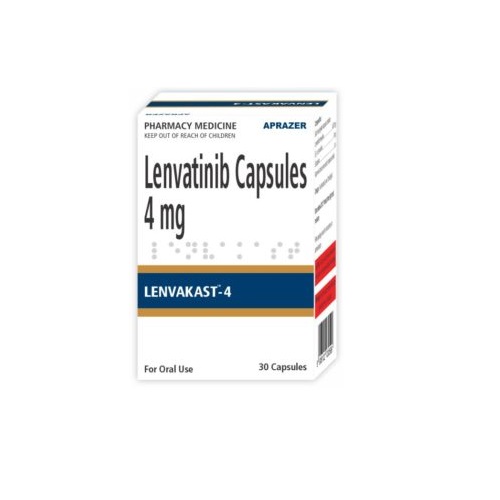
Lenvatinib Capsules
Anticancer Medicine / Multi-Kinase Inhibitor
Lenvatinib Capsules
Aprazer Healthcare is a WHO-GMP certified manufacturer and exporter of Lenvatinib Capsules (Lenvakast 4mg, 10mg). Global standard quality for Thyroid, Liver, and Kidney cancer.
Formulation
Capsules
Standard
WHO-GMP Certified Quality
Supply Type
Global Export & Institutional Supply
Finished Commercial Brand
Available finished formulation under our brand name Lenvakast 4.
View Commercial Product Details
WHO-GMP Certified
Global Export Ready
Quality Assured
Formulation Insights
Comprehensive Medical Overview
Lenvatinib Capsules
Classification: Anticancer Medicine / Multi-Kinase InhibitorAbout Lenvatinib Capsules
Lenvatinib is an oral multi-targeted receptor tyrosine kinase inhibitor that selectively inhibits vascular endothelial growth factor (VEGF) and fibroblast growth factor (FGF) receptors, indicated globally for advanced thyroid cancer, hepatocellular carcinoma, and renal cell carcinoma.Lenvakast (Lenvatinib Capsules) – Manufactured by Aprazer Healthcare
Lenvakast is available in 4 mg and 10 mg oral capsule formulations, manufactured under strict WHO-GMP compliance by Aprazer Healthcare. As an international pharmaceutical manufacturer and bulk exporter from India, we deliver certified oncology medicines to tertiary hospitals, cancer centers, and distribution networks worldwide.Approved Indications & Uses of Lenvatinib Capsules
Lenvatinib is approved for several challenging oncological conditions:- Differentiated Thyroid Cancer (DTC): Indicated for locally recurrent or metastatic, progressive, radioactive iodine-refractory differentiated thyroid cancer (RAI-rDTC).
- Hepatocellular Carcinoma (HCC): Approved as first-line systemic monotherapy for adult patients with unresectable hepatocellular carcinoma.
- Advanced Renal Cell Carcinoma (RCC):
- In combination with pembrolizumab for first-line treatment of adult patients with advanced RCC.
- In combination with everolimus following one prior anti-angiogenic therapy.
- Advanced Endometrial Carcinoma (EC): In combination with pembrolizumab for patients with advanced endometrial carcinoma that is mismatch repair proficient (pMMR) or not MSI-H, who have disease progression following prior systemic therapy.
Mechanism of Action (How Lenvatinib Works)
Lenvatinib exerts potent anti-tumor and anti-angiogenic activity through targeted kinase inhibition:- Receptor Tyrosine Kinase Blockade: Selectively inhibits VEGFR1 (FLT1), VEGFR2 (KDR), and VEGFR3 (FLT4), alongside FGFR1, FGFR2, FGFR3, and FGFR4.
- Dual Anti-Angiogenic Activity: Inhibiting both the VEGF and FGF pathways simultaneously shuts down alternative and compensatory angiogenic signaling pathways within the tumor.
- Inhibition of Additional Kinases: Also targets platelet-derived growth factor receptor alpha (PDGFRα), RET, and KIT.
- Tumor Starvation & Regression: Halts neovascularization, stops oxygen and nutrient supply to malignant cells, induces apoptosis, and shrinks tumor burden.
Side Effects of Lenvatinib
Common Side Effects:- Hypertension (observed in over 70% of treated patients)
- Proteinuria (protein leakage in urine, requiring routine dipstick surveillance)
- Gastrointestinal disturbances: Diarrhea, nausea, vomiting, abdominal pain, and stomatitis
- Palmar-plantar erythrodysesthesia (hand-foot skin reaction) and skin rash
- Fatigue, asthenia, and musculoskeletal pain
- Dysphonia (hoarseness of voice) and mild hair thinning
- Decreased appetite and weight loss
- Hypertensive crisis and posterior reversible encephalopathy syndrome (PRES)
- Arterial thromboembolic events (myocardial infarction, cerebral ischemia/stroke)
- Severe hemorrhagic events (epistaxis, GI bleeding, hemoptysis)
- Gastrointestinal perforation and fistula formation
- Osteonecrosis of the Jaw (ONJ)
- Hepatotoxicity and acute renal failure
- QTc interval prolongation and cardiac dysfunction
Clinical Precautions & Safe Administration
- Oral Dosing: Administer once daily at the same time each day, with or without food. Capsules must be swallowed whole with water; never crush, chew, or open the capsules.
- Embryofetal Toxicity: Lenvatinib is teratogenic. Females of reproductive potential must use effective non-hormonal contraception during therapy and for at least 30 days after the final dose.
- Oral & Dental Screening: A comprehensive dental examination and completion of invasive dental procedures must be performed prior to starting Lenvatinib to prevent Osteonecrosis of the Jaw (ONJ).
- Alertness: Fatigue and dizziness can impair alertness; patients should avoid driving or operating machinery if affected.
- Elderly Monitoring: Patients aged 65 and older exhibit higher rates of adverse events and require individualized dose titration.
Drug Interactions
- QT-Prolonging Agents: Extreme caution with antiarrhythmics, macrolides, fluoroquinolones, azole antifungals, 5-HT3 antiemetics (ondansetron), and antipsychotics.
- Anticoagulants & NSAIDs: Concomitant use with warfarin, low molecular weight heparins, DOACs, or NSAIDs significantly compounds hemorrhagic risk.
- CYP3A4 / P-gp Modulators: Agents such as rifampin, carbamazepine, phenytoin, and ketoconazole can alter systemic exposure; monitor clinical efficacy and toxicity.
Functions & Parameters to Monitor
- Blood pressure: Monitor baseline, weekly for the first 2 months, then at least monthly thereafter; maintain BP with standard antihypertensives.
- Urinalysis for Proteinuria: Regular dipstick checks; monitor 24-hour urine protein if dipstick shows 2+ or greater.
- ECG and Electrolytes: Periodically evaluate QTc intervals and maintain potassium, magnesium, and calcium within normal limits.
- Liver & Kidney Function: Monthly monitoring of ALT, AST, bilirubin, serum creatinine, and BUN.
- Thyroid Function: Baseline and monthly TSH monitoring; initiate or adjust levothyroxine therapy as clinically indicated.