
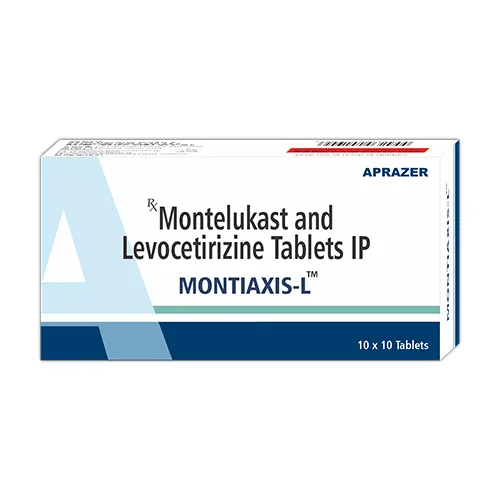
Montelukast & Levocetirizine Tablets
Aprazer Healthcare – Leading WHO-GMP certified manufacturer and global exporter of Montelukast & Levocetirizine Tablets (Montiaxis L). High-quality, reliable, affordable medicine.
Available finished formulation under our brand name MONTIAXIS L.
View Commercial Product DetailsFormulation Insights
Comprehensive Medical Overview
Montelukast & Levocetirizine Tablets
Classification: Anti-allergic & Leukotriene Receptor Antagonist
About Montelukast & Levocetirizine Tablets
A dual combination of Levocetirizine (second-generation antihistamine) and Montelukast (leukotriene receptor antagonist), prescribed for allergic rhinitis, chronic urticaria, and relief of seasonal allergy and asthma symptoms.
Montelukast & Levocetirizine Tablets (Montiaxis L) Manufactured by Aprazer Healthcare
Montiaxis L is formulated and manufactured under strict WHO-GMP compliance, delivering proven bioequivalence, therapeutic efficacy, and clinical reliability globally.
Montelukast & Levocetirizine
Classification: Dual Anti-Allergic & Leukotriene Receptor Antagonist
What is the Montelukast–Levocetirizine Combination?
It is a dual-action oral medication combining an H1-receptor antihistamine (Levocetirizine) and a cysteinyl leukotriene receptor antagonist (Montelukast) to treat allergic rhinitis, persistent congestion, and urticaria.
Montiaxis L (montelukast–levocetirizine), manufactured by Aprazer Healthcare, provides comprehensive dual-action relief across upper and lower respiratory allergic pathways.
Aprazer Healthcare – Global Quality in Respiratory & Allergy Care
Aprazer Healthcare is a WHO-GMP certified manufacturer and exporter delivering high-grade anti-allergic formulations across Asia, Africa, and the Americas.
Indications & Uses
- Allergic rhinitis: Relieves seasonal hay fever and year-round perennial allergic rhinitis, mitigating sneezing, runny nose, and nasal congestion.
- Comorbid asthma and allergy: Assists in long-term combined management of allergic airway inflammation and bronchial hyperresponsiveness.
- Chronic urticaria: Effectively relieves allergic skin hives, pruritus, and erythema.
- Exercise-induced bronchoconstriction: Helps prevent acute airway narrowing provoked by exercise in patients with allergic asthma.
Mechanism of Action
• Montelukast blocks the cysteinyl leukotriene CysLT1 receptor in airways, preventing smooth muscle contraction, vascular permeability, and excessive mucus secretion.
• Levocetirizine selectively blocks peripheral histamine H1-receptors, rapidly alleviating sneezing, itchy/watery eyes, and rhinorrhea.
Precautions & Side Effects
- Drowsiness: Levocetirizine can cause mild sedation; evening administration before bed is strongly recommended.
- Neuropsychiatric monitoring: Montelukast has an FDA alert for mood changes, agitation, sleep disturbances, and depression; report any mood changes immediately.
- Not for acute asthma attacks: This combination is not a rescue inhaler; it does not relieve acute bronchospasm.
- Allergy skin tests: Must be discontinued several days prior to scheduled allergy prick tests.