
Rabeprazole or Famotidine: Which is Better?

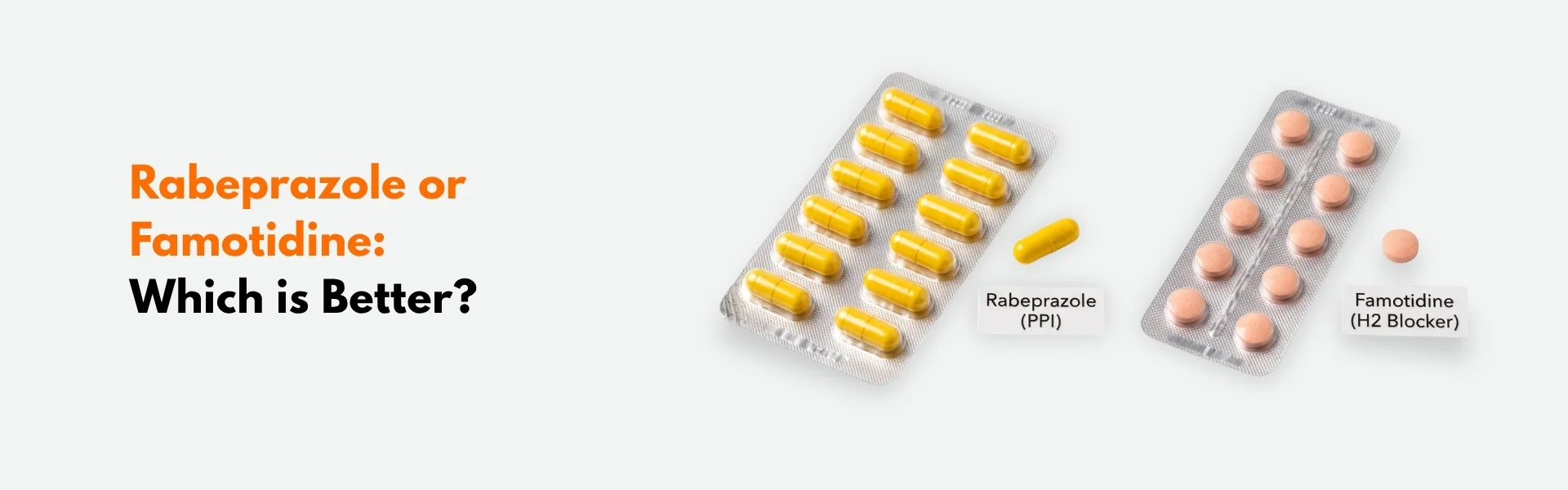
They have different mechanisms of action.
The choice of drug depends on the duration of symptoms and the disease condition.
Rabeprazole is generally used for persistent symptoms.
Famotidine may be used for conditions like heartburn after eating food.
It includes issues that may occur infrequently.
How are they different in their mechanism of action?
Rabeprazole-
It is a proton pump inhibitor.
It binds to the acid-secreting pump in the stomach lining.
It blocks the pump.
It reduces the overall acid secretion.
Famotidine –
It blocks the H2 receptors present in the parietal cells of the stomach.
Histamine acts as a trigger to secrete acid.
Blocking the histamine receptors reduces acid production.
When is rabeprazole prescribed?
It is a PPI and may be used for long-term relief.
It is given to relieve frequent to persistent symptoms.
It provides sustained effects.
Common conditions it may be used for:
- Heartburn
- Acid reflux
- GERD
When is famotidine used?
It works faster than PPIs.
It is used in conditions that are occasional.
It may be used in conditions where acidity is triggered by food or other factors.
It can be used on demand.
Why is famotidine used for short-term effect?
It is preferred for short-term treatment.
After continuous use, a person may develop tolerance to the drug.
It may not produce the desired effects.
Can I use them together?
They can be used together only upon prescription.
They may be used in severe conditions to get stronger acid suppression.
They must be used at different times.
Rabeprazole can be used in the morning.
Famotidine may be prescribed at bedtime to prevent nocturnal acid breakthrough (NAB).
Why does timing matter?
Taking both at the same time reduces the efficacy of the PPI treatment.
PPIs like rabeprazole require actively secreting acid pumps stimulated by meals to bind effectively.
Because famotidine suppresses acid stimulation beforehand, it puts proton pumps into a resting state, blunting rabeprazole activation.
Important precautions patients must follow:
The two drugs must not be used at the same time.
After long-term use, rabeprazole must not be stopped abruptly to prevent rebound acid hypersecretion; dosages should be tapered gradually under medical guidance.
Long-term use must be monitored for:
- Nutrient deficiencies
- Bone density
- Infection risks
- Drug interactions
Aprazer’s commitment to promote better care and treatment
Aprazer Healthcare is a gastroenterology medicine manufacturer.
With a specialty in gastroenterology, we focus on manufacturing advanced formulations, including gastro-resistant preparations.
Our extensive portfolio comprises:
- Proton pump inhibitors
- H2-receptor antagonists (H2 blockers)
- Antibiotics