
Understanding Hormone Therapy in Prostate Cancer

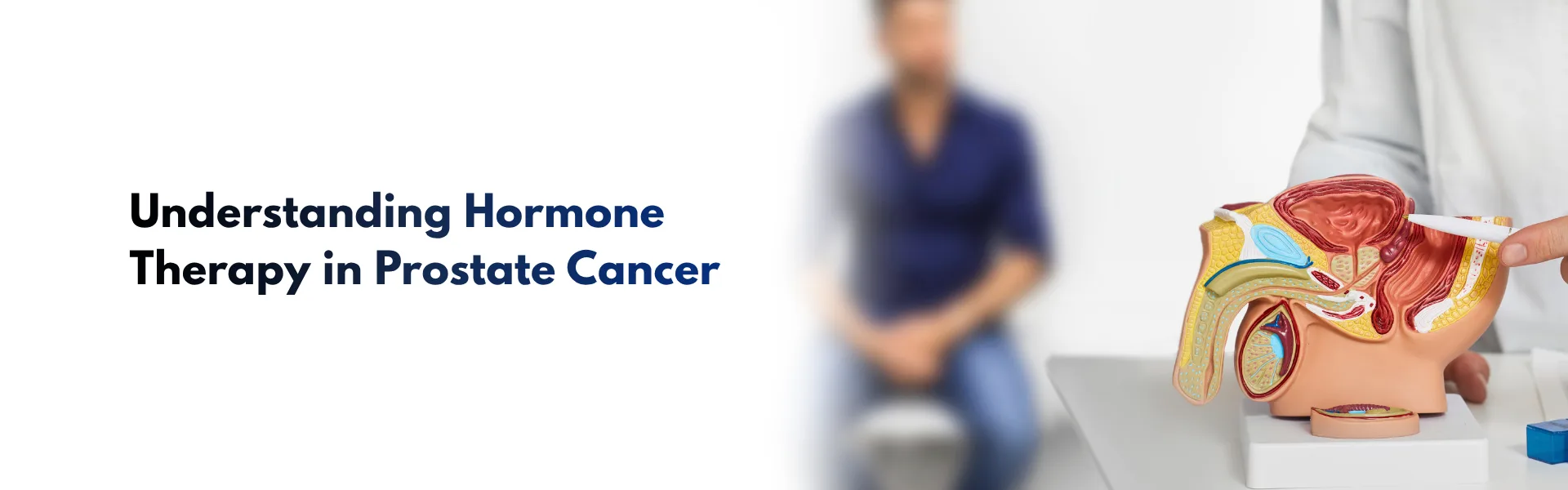
It is used as androgen deprivation therapy.
It blocks androgen signaling or its production, which fuels tumor growth.
The androgen-dependent cancers grow in response to male hormones.
How does hormone therapy work in prostate cancer?
Many times, prostate cancer is initially androgen-dependent.
The cancer grows with the availability of androgens.
The cancer cells rely on androgens for survival.
By blocking the androgen-tumor connection, tumor growth can be slowed or suppressed.
Working and types of hormone therapies used in prostate cancer:
- Lowering testosterone production:
Most of the testosterone is secreted by the testicles.
The testicular production of testosterone is reduced.
This leads to starvation of the cancer cells.
It inhibits their growth.
Examples include:
- Leuprolide
- Goserelin
- Blocking the binding of androgens to cancer cells:
The medications block the receptors or modify signaling pathways activating androgen receptors.
These include medicines such as:
- Bicalutamide
- Enzalutamide
- Completely blocking the production of androgens:
It includes a comprehensive blockade of male hormones.
Testosterone is also produced by the adrenal glands or cancer cells.
Testosterone production is blocked in these areas.
The medicines include:
Abiraterone Acetate
- Surgery
It involves the removal of testicles.
It reduces the production of male sex hormones.
The use of hormone therapy in prostate cancer:
It can be used alone or in combination with other therapies depending on cancer stage.
Hormone therapy helps reduce cancer progression.
It can be used in various clinical settings, including:
- Alongside radiation therapy
- For locally advanced or metastatic prostate cancer
- For cancer recurrence in certain patients
What are the side effects of hormone therapy?
It causes adverse effects due to reduced androgen levels.
Testosterone maintains several functions in the body.
The reduced levels may interrupt normal body functioning.
It may cause sexual dysfunction:
- Loss of libido
- Erectile dysfunction
- Shrunken testicles
- Tenderness in the breast
It may cause physical or energy changes:
- Hot flushes
- Night sweats
- Weakness
- Loss of muscle mass
- Bone thinning
- Anemia
Metabolic side effects include:
- Weight gain
- Changes in cholesterol levels
- Insulin resistance
It may increase the risk of high BP, heart attack, or stroke in certain men.
Hormone therapy may affect cognitive functions, such as:
- Changes in mood
- Depression
- Brain fog
- Memory lapses
Why is PSA monitoring required in prostate cancer treatment?
It is used to evaluate treatment response:
If PSA levels are low, they may indicate that cancer activity is under control.
A higher PSA level may indicate progression of disease.
It helps prevent under-treatment:
Cancer recurrence or progression can be detected biochemically through rising PSA levels.
This helps identify renewed disease activity long before visible symptoms appear.
Preventing overtreatment:
Certain tumors may not need to be removed immediately.
Regular surveillance is required.
PSA levels help interpret any changes or progression of disease.
Aprazer Healthcare: Supporting Cancer Care through Affordable Medicines
Aprazer Healthcare is a pharmaceutical manufacturer specializing in oncology drugs.
We manufacture a comprehensive range of oncology medicines.
Our oncology portfolio spans oncology orals and oncology injectables.
We supply generic oncology medicines to countries in Asia, Africa, and America.
Our flagship product for prostate cancer is:
Indenza – Enzalutamide
It is an androgen receptor inhibitor.
It is widely used to treat advanced or metastatic prostate cancer.