
Can Liver Tests be Normal in Chronic Liver Disease

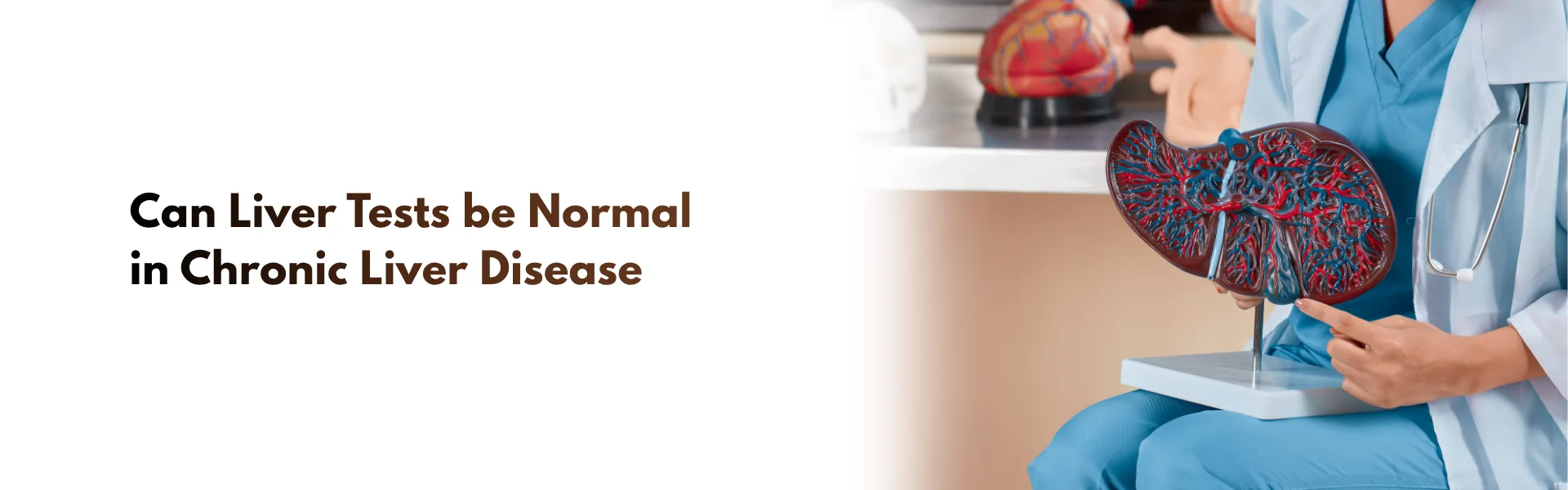
Overall liver health cannot be determined by blood tests alone.
They may not detect fatty liver or a chronic issue.
Liver enzymes may not necessarily increase, but the disease may continue to progress slowly.
Compensated cirrhosis:
Tests may happen to be normal during liver damage.
The liver has large functional reserves.
The healthy cells may continue to perform essential functions.
Even with scarring, the liver enzymes may remain normal.
Fatty liver or Fibrosis:
The standard tests help measure liver enzymes.
Even in advanced chronic liver damage, liver enzymes may remain within the normal range.
Fatty liver or fibrosis causes changes at the structural level.
These cannot be measured by standard liver function tests.
Hepatitis B/C infections:
Liver enzymes may be affected or may remain normal in chronic viral infections.
The viral infection is evaluated by comprehensive screening.
How can chronic liver disease be measured?
Chronic liver disease must be evaluated by several diagnostic methods, including:
- Liver function test
- Complete blood count
- Ultrasound of the liver
FibroScan helps measure stiffness in liver tissues.
FIB-4 score can be used to evaluate the risk of advanced liver fibrosis.
Liver biopsy can be done in selected individuals; it is not a routine test.
What happens if liver disease remains undetected?
If the liver disorder is undetected or untreated for a long time, it slowly progresses to a severe condition.
It can cause tissue scarring that may be permanent.
The stages of silent progression:
- Inflammation / fatty liver –
Fat may accumulate in the liver for several reasons.
It may cause inflammation or injury to liver tissues.
It may not show symptoms at early stages.
- Fibrosis- Persistent inflammation may trigger scarring of liver tissue.
It may lead to the formation of a stiff, fibrous scar.
- Cirrhosis-
The liver disease can continue to progress.
It can form a permanent scar.
Scar tissue disrupts the normal liver structure.
Major risks of untreated liver disorder-
Internal bleeding-
Hard, stiff liver tissue may resist blood flow.
It may force blood flow under high pressure.
It can lead to the rupture of enlarged, fragile blood vessels (varices).
Portal hypertension –
Severe scarring of liver tissue may interrupt blood flow in the liver.
This may lead to an increase in blood pressure in the portal vein.
Fluid accumulation-
A diseased liver may not produce enough albumin.
Albumin helps maintain fluid inside blood vessels.
Several other factors combined with reduced albumin may cause fluid accumulation.
Hepatic encephalopathy –
Impaired liver functioning leads to accumulation of toxins.
Toxins may circulate through the blood, affecting the brain.
It may affect brain function and cause memory loss.
Liver cancer – Continuous liver scarring may increase the risk of liver cancer.
Liver failure –
It is a condition in which the liver is not able to perform vital functions.
Can advanced liver disease remain asymptomatic?
Chronic liver disorders may not show any symptoms for years.
Many times, they can slowly progress into a life-threatening condition.
Common symptoms of advanced disease may include:
- Weakness
- Loss of appetite
- Unusual weight loss
- Abdominal pain
- Swelling in legs or abdomen
- Yellowish eyes or skin
- Easy bruising or bleeding
- Itching of the skin
- Confusion
- Altered behavior
- Muscle wasting
Bottom Note-
Chronic liver disorders may progress silently for years without any symptoms.
People at risk of chronic liver disease must follow regular monitoring and evaluations.
At Aprazer Healthcare, we are focused on manufacturing antivirals for infectious liver diseases.
We manufacture an affordable range of Hepatitis medicines.
We are a recognized hepatology medicine manufacturer.
Our portfolio comprises:
We supply hepatitis medicines globally.
We have a global footprint across Asia, the Americas, and Africa.