
Parkinson’s disease – Treatment and Drugs

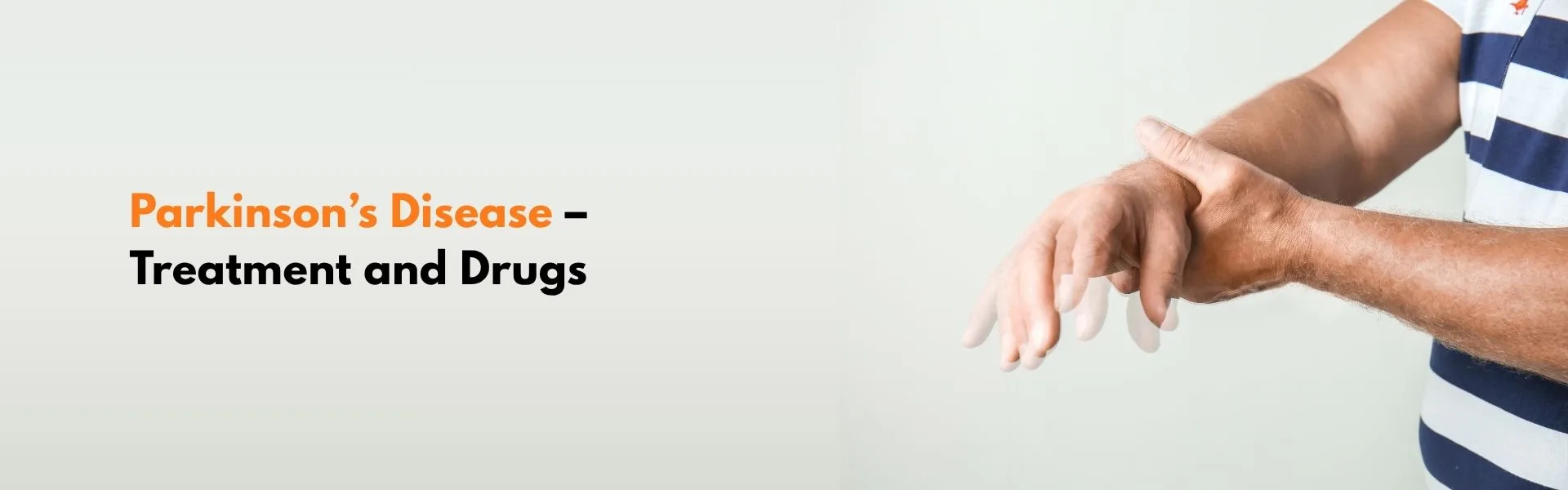
Parkinson’s is not a single disease.
It is a complex syndrome that occurs due to different biological processes.
The nerve cells in the brain stop releasing neurotransmitters.
The deficiency in chemicals affects neuron firing.
It also leads to severe cognitive changes.
What are the causes of Parkinson’s disease?
It is the slow degradation of nerve cells.
It is the loss of neurons.
It lowers chemical messengers in the brain.
It leads to loss of Dopamine/Nor-epinephrine.
It controls many body functions.
- Motor functions
- Heart rate
- Blood pressure
- Tiredness
- Sleep disturbances
Parkinson’s disease symptoms-
- Shaky movement in hands /finger.
- Slow movement, taking longer to walk/dress.
- Stiffness in the limbs
- Increased risk of fracture
- Trouble sleeping
- Constipation
- Depression
- Slurred speech
- Blurred vision
Severe complications caused by Parkinson’s disorder-
Parkinson’s disorder affects day-to-day life, affecting a person’s cognitive and physical functions.
- It affects people’s memory, language, and reasoning skills.
- Emotional instability
- Depression /anxiety
- Trouble swallowing /chewing
- Sleep disorders
- Nightmares
- BP changes
- Bladder functions
- Sexual dysfunction
- Smell loss
What are the risk factors of developing Parkinson’s disease?
- Growing Age – With age the neurons in the brain degenerate.
The risk of developing Parkinson’s increases with the growing age.
The risk is higher above 70 years of age.
- Genetics – The risk is higher in people with a family member having Parkinson’s.
- Gender – Males have a higher risk of developing it.
- Exposure to toxins-
Environmental pollution, and harmful chemicals in food.
Can Parkinson’s occur at a younger age?
Parkinson’s can affect young people.
It is mainly caused by genetic inheritance.
It is called juvenile Parkinson’s.
It is different from Parkinson’s in older people.
The disease progresses very slowly.
Young people experience more dystonia and muscular contractions.
They have fewer instances of cognitive issues.
What is the treatment for Parkinson’s disorder?
The treatment involves the restoration of dopamine and relief of the symptoms.
It includes –
- Physical/speech therapies
- Lifestyle adjustments
- Medications
The common drugs used to treat Parkinson’s disorder
- Carbidopa-levodopa-
Levodopa changes to Dopamine.
It enhances the Dopamine level in the brain.
It widely improves motor functions.
Dopamine agonist –
These mimic dopamine in the brain.
It binds to dopamine receptors; it activates the receptors.
It is used to treat –
- Parkinson
- Restless leg syndrome
- High prolactin levels
Pramipexole
- MAO-B, COMT inhibitors –
It prevents dopamine breakdown.
It is taken alongside levodopa to enhance dopamine activity.
- Selegiline
- Rasagiline
- Amantadine –
It blocks the NMDA receptor.
It decreases glutamate activity
It boosts dopamine activity.
It reduces motor function.
Other supportive medicines include –
- Antidepressants for cognitive improvement.
- Drugs for GIT and autonomic issues.
- Laxatives for severe constipation.
Do not stop taking medicine abruptly. Why?
It shows sudden withdrawal symptoms.
The immediate stopping of the medicine.
It leads to a severe drop in dopamine levels.
- Severe muscle rigidity
- Complete loss of movement
- Unstable blood pressure
- Difficulty in breathing, swallowing
- Extreme anxiety
- Panic attacks
It is advised to gradually taper the medications.
A leading Contract Pharmaceutical Manufacturer-
Aprazer Healthcare is the leading pharmaceutical manufacturer.
We manufacture world-standard drugs.
We are globally recognized, offering world-class services.
Our dealings are based on transparent communication.
- WHO-GMO/EU-GMP compliance
- Robust quality products
- Audit-ready labs
- Export-ready dossiers
- Worldwide distribution